Digital transformation rarely fails because an organization chose the wrong technology.
The cloud platform may be selected. A new ERP may go live. AI pilots may show promising results. A CRM implementation may be completed on schedule.
And yet, the expected business value may never materialize.
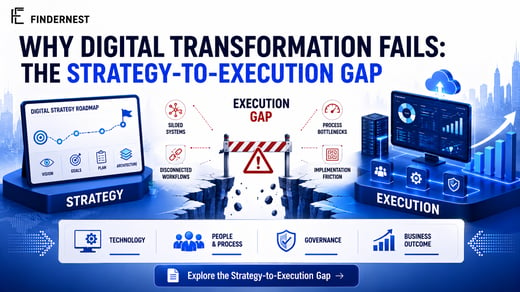
The real challenge is not simply deciding what technology to adopt. It is translating strategic intent into coordinated execution across technology, data, processes, people, governance, and operations.
This is the strategy-to-execution gap.
McKinsey's research found that while around eight in ten respondents said their organizations had begun a digital transformation, only 14% reported sustained performance improvements, and just 3% reported complete success in sustaining their change efforts. The research also identified focused objectives, adaptive planning, agile execution, and clear accountability as characteristics of more successful transformations. McKinsey's digital transformation research
A digital transformation roadmap therefore cannot be a list of technology projects.
It must answer five fundamental questions:
Where are we today? Where do we need to go? What should change first? How will we execute it? And how will we know it worked?
A Roadmap Is Not a List of Technology Projects
A credible transformation roadmap connects business ambition with execution capacity.
It translates strategic objectives into a sequence of capabilities, initiatives, dependencies, investments, ownership models, and measurable outcomes.
|
Roadmap Layer
|
Key Question
|
Typical Output
|
|
Business Strategy
|
What needs to improve?
|
Strategic objectives and KPIs
|
|
Current-State Assessment
|
What is holding us back?
|
Capability and technology baseline
|
|
Target State
|
What should the future look like?
|
Architecture and operating model
|
|
Prioritization
|
What should happen first?
|
Transformation portfolio
|
|
Execution
|
How will we deliver it?
|
Teams, milestones, governance
|
|
Adoption
|
Will the organization change?
|
Training and change plan
|
|
Measurement
|
Did it create value?
|
Outcome and ROI dashboard
|
This is where many organizations get stuck.
They create a roadmap that describes the destination but not the system required to reach it.
A successful transformation requires the business strategy, operating model, technology architecture, talent model, and governance structure to evolve together. That principle is central to modern operating-model transformation, as explored by Deloitte's transformation research.
The Transformation Journey: From Strategy to Execution
A practical enterprise roadmap can be structured as a continuous cycle rather than a one-time program.
[ Business Strategy ]
↓
[ Current-State Assessment ]
↓
[ Target State & Architecture ]
↓
[ Prioritize Initiatives ]
↓
[ Execute & Modernize ]
↓
[ Adoption & Change ]
↓
[ Measure Outcomes ]
↺ Feed insights back into prioritization
Transformation is not:
Strategy → Projects → Done
It is:
Strategy → Execution → Measurement → Optimization → Next Transformation Cycle
That distinction becomes increasingly important as enterprises balance AI adoption, cloud modernization, cybersecurity, data modernization, enterprise applications, and workforce capability at the same time.
Phase One: Start With Business Outcomes, Not Technology
One of the most common transformation mistakes is beginning with a solution.
“We need AI.”
“We need to move to the cloud.”
“We need a new CRM.”
“We need to modernize the ERP.”
These may eventually be the right technology decisions. But they are not business objectives.
A stronger starting point is:
- Reduce customer response time
- Improve operational productivity
- Reduce infrastructure costs
- Eliminate repetitive manual work
- Improve decision-making speed
- Increase system resilience
- Accelerate product and service delivery
Technology should then be evaluated based on its ability to contribute to those outcomes.
A practical transformation equation
Business Problem → Desired Outcome → Capability Gap → Initiative → KPI
For example:
Slow customer response → Faster engagement → Fragmented customer data → CRM + workflow automation → Reduced response time
This approach prevents technology from becoming the objective itself.
FindErnest's digital transformation practice follows a business-first approach that connects modernization initiatives with operational efficiency, customer experience, scalability, and measurable business outcomes.
The same principle appears in FindErnest's analysis of 75+ delivered projects across 100+ clients: transformation creates greater value when technology investments remain connected to the business problem they are intended to solve. The ROI of Digital Transformation: What 75+ Projects Taught Us
Phase Two: Build a Current-State Baseline
A roadmap cannot be credible without a clear understanding of the starting point.
The assessment should go beyond applications and infrastructure.
|
Dimension
|
What to Assess
|
|
Technology
|
Legacy systems, applications, infrastructure
|
|
Data
|
Quality, accessibility, integration, governance
|
|
Processes
|
Manual work, bottlenecks, duplication
|
|
Security
|
Identity, vulnerabilities, compliance
|
|
People
|
Skills, ownership, capacity
|
|
Operations
|
Reliability, support, monitoring
|
|
Economics
|
TCO, cloud spend, licensing
|
This stage often reveals that the visible problem is not the real constraint.
An organization may believe it needs an AI platform when fragmented data is the actual barrier.
A cloud migration program may stall because tightly coupled applications cannot move efficiently.
A company may have a strong technology strategy but lack the specialized engineering talent required to execute it.
The roadmap should therefore distinguish:
Symptoms → Root Causes → Capability Gaps → Required Changes
Without this step, organizations risk investing in solutions that optimize the wrong problem.
Phase Three: Define the Target State
Once the current state is understood, leadership can define where the organization needs to go.
But the target state should describe more than a future technology stack.
It should connect:
Business capabilities + Processes + Technology + Data + Operating Model + Talent + Governance
A modern enterprise transformation can be viewed as:
[ Business Strategy ]
↓
[ Business Capabilities ]
↓
[ Digital Processes ]
↓
[ Applications & Platforms ]
↙ ↘
[ Data & AI ] [ Cloud & Infrastructure ]
↘ ↙
[ Security & Governance ]
↓
[ Operations & Observability ]
↓
[ Measurable Business Outcomes ]
This architecture matters because modern transformation initiatives are increasingly interconnected.
An AI initiative may depend on governed data, APIs, cloud infrastructure, security controls, engineering platforms, and new workforce capabilities.
A cloud transformation may require application modernization before migration.
A new customer platform may require process redesign and adoption planning before it can create value.
The target state must therefore define how these capabilities work together, not simply which technologies will be purchased.
Phase Four: Prioritize the Transformation Portfolio
Not every initiative should begin at once.
A roadmap with 30 or 40 projects may look comprehensive, but it can quickly become an execution problem.
A more useful prioritization model considers:
Business Value × Urgency × Feasibility × Dependency
|
Initiative
|
Business Value
|
Complexity
|
Key Dependency
|
Priority
|
|
Customer data consolidation
|
High
|
Medium
|
Data governance
|
High
|
|
Legacy modernization
|
High
|
High
|
Architecture
|
High
|
|
Process automation
|
Medium–High
|
Low
|
Process redesign
|
High
|
|
AI knowledge assistant
|
High
|
Medium
|
Data + security
|
Medium
|
|
Infrastructure optimization
|
High
|
Medium
|
Cloud assessment
|
High
|
The objective is not to select the most exciting technology.
It is to create the highest-value sequence of changes.
McKinsey's research similarly highlights the importance of focusing transformation efforts and adapting priorities as conditions change rather than treating the original roadmap as fixed. McKinsey — Five Moves to Make During a Digital Transformation
A practical sequence might look like:
Business Priorities → Governance → Data & Architecture Foundations → Modernization → Automation → AI Scale
The exact order will vary, but dependencies should drive sequencing.
Phase Five: Turn the Roadmap Into an Execution System
This is where many transformation programs lose momentum.
The roadmap explains what should happen.
Execution determines whether it actually happens.
For each major initiative, leadership should establish:
- A business owner accountable for the outcome
- A delivery owner accountable for execution
- Required technical and business capabilities
- Cross-functional dependencies
- Decision and escalation mechanisms
- Delivery milestones
- Risk controls
- Measurable success criteria
The execution loop
[ Prioritized Initiative ]
↓
[ Business Owner ]
↓
[ Transformation Team ]
↓
[ Build / Modernize ]
↓
[ Deploy ]
↓
[ Adoption ]
↓
[ Measure KPI ]
↓
[ Executive Review ]
↺ Feed results into the next priority
This creates accountability beyond project completion.
A CRM implementation should not be considered successful simply because the platform is live.
The real question is whether response time, sales productivity, reporting visibility, conversion, or customer experience actually improved.
FindErnest's How We Work framework follows a structured Discover → Strategize → Build → Operate → Optimize approach designed to connect strategy with implementation, ongoing operations, and continuous improvement.
Case Study: Why Transformation ROI Must Be Designed Into the Roadmap
FindErnest's published analysis of its transformation portfolio provides several examples of why implementation alone is not the outcome. The ROI of Digital Transformation: What 75+ Projects Taught Us
Cloud modernization
One published case involved an academic hospital operating an aging mainframe environment costing approximately $1 million annually to maintain.
The transformation involved assessing legacy assets and migrating 54 applications to Microsoft Azure, while making historical data more accessible and improving reporting capabilities.
The reported outcome included an estimated 95% reduction in IT maintenance costs.
The lesson is not simply that cloud migration reduces costs.
The value came from connecting the technical migration to a measurable operational and financial objective.
Customer operations transformation
Another published example focused on improving customer operations through CRM customization, workflow automation, reporting, process improvement, and user onboarding.
The reported results included:
- 35% reduction in manual CRM activities
- 30% faster lead response times
- 40% improvement in reporting visibility
The value was not the software deployment itself.
It came from connecting technology with process redesign, adoption, automation, and measurable business outcomes.
ERP modernization
A manufacturing organization with approximately 37,000 employees across 12 countries standardized its SAP environment following a merger.
The transformation reduced daily batch jobs from 300 to 180, while improving processing efficiency and reducing operational complexity.
These examples reinforce a broader principle:
The business case should be designed into the transformation roadmap before execution begins.
Phase Six: Technology Without Adoption Is Incomplete Transformation
A technically successful program can still fail if people continue using old processes.
This becomes particularly important when introducing:
- AI assistants
- Automated workflows
- New ERP or CRM platforms
- Cloud operating models
- Data platforms
- New engineering practices
Adoption should therefore be designed alongside implementation.
The transformation plan should include:
Training + Process Redesign + Role Clarity + Governance + Feedback Loops + Ongoing Support
This is why technology, talent, and transformation should not be treated as separate workstreams.
FindErnest's Technology, Talent & Transformation model connects technology capabilities, talent, business strategy, engineering execution, and operational transformation rather than treating them as isolated services.
Measure Transformation Through Outcomes
A mature roadmap needs an outcome dashboard.
Leadership should look beyond:
- Projects completed
- Systems deployed
- Users migrated
- Features released
Instead, measure the change in the business.
|
Outcome Area
|
Example KPIs
|
|
Financial
|
ROI, cost reduction, revenue impact
|
|
Operational
|
Processing time, automation rate
|
|
Customer
|
Response time, retention, satisfaction
|
|
Technology
|
Availability, latency, deployment frequency
|
|
Workforce
|
Productivity, adoption, capability growth
|
|
Risk
|
Security incidents, compliance gaps
|
|
Data
|
Quality, accessibility, reporting latency
|
FindErnest's published transformation model provides outcome examples including 30% lower cloud costs, 99.95% system uptime, and 25% higher operational productivity. These are published outcome examples rather than universal industry benchmarks. FindErnest — How We Work
The broader principle is simple:
Measure what changed in the business—not just what changed in the technology.
A Practical 12–24 Month Digital Transformation Roadmap
Every enterprise requires a different sequence, but a representative roadmap might look like this:
|
Workstream
|
0–3 Months
|
3–6 Months
|
6–12 Months
|
12–24 Months
|
|
Strategy
|
Business case
|
KPI refinement
|
Portfolio review
|
Continuous strategy
|
|
Technology
|
Assessment
|
Target architecture
|
Modernization
|
Optimization
|
|
Data
|
Governance baseline
|
Integration
|
Advanced analytics
|
AI-ready capabilities
|
|
Cloud
|
TCO assessment
|
Migration priorities
|
Optimization
|
Continuous FinOps
|
|
AI
|
Use-case discovery
|
Controlled pilots
|
Production AI
|
Scaled intelligent workflows
|
|
Talent
|
Skills assessment
|
Capability building
|
Team scaling
|
Continuous upskilling
|
|
Governance
|
Ownership model
|
Controls
|
Measurement
|
Continuous optimization
|
This should not be treated as a fixed schedule.
A transformation roadmap must evolve as business priorities, technology, regulatory requirements, and execution realities change.
The strongest roadmap is not necessarily the most detailed one.
It is the one that provides enough structure to guide investment while remaining adaptable enough to respond to reality.
Roadmap vs. Transformation System
A roadmap tells an organization what it intends to do.
A transformation system enables the organization to actually do it.
That system requires:
Strategy
↓
Current-State Assessment
↓
Target Architecture & Operating Model
↓
Prioritized Portfolio
↓
Technology + Talent
↓
Execution Governance
↓
Adoption
↓
Measurement
↓
Continuous Optimization
This is why digital transformation should not be treated as a one-time IT project.
It is an ongoing operating discipline.
Frequently Asked Questions
What is a digital transformation roadmap?
A digital transformation roadmap is a structured plan that connects business objectives with the technology, data, processes, people, governance, and capabilities required to achieve them. It defines priorities, dependencies, ownership, execution stages, and measurable outcomes.
What should come first in a digital transformation roadmap?
Start with business outcomes and a current-state assessment. Technology decisions should follow an understanding of the business problem, capability gaps, architecture constraints, workforce requirements, and success metrics.
How long does digital transformation take?
There is no universal timeline. Individual initiatives may take months, while enterprise-wide transformation can span several years. A strong approach delivers measurable outcomes in stages rather than waiting for a single “transformation completion” date.
How do you measure digital transformation success?
Measure business impact alongside technical delivery. Relevant KPIs can include cost reduction, productivity, customer response time, automation, revenue impact, reliability, workforce adoption, and risk reduction.
Turn Your Transformation Strategy Into an Execution Plan
For enterprise leaders, the most expensive transformation problem is often not choosing the wrong technology.
It is moving forward without knowing where the real bottlenecks are.
A fragmented application landscape, weak data foundations, cloud inefficiencies, skills gaps, unclear ownership, or disconnected transformation initiatives can quietly increase cost and execution risk long before the problem becomes visible at the board level.
This is where FindErnest brings Technology, Talent & Transformation together.
Through its digital transformation capabilities, FindErnest works across enterprise modernization, AI and intelligent automation, cloud transformation, data and analytics, DevOps and platform engineering, cybersecurity, enterprise applications, and managed services.
But the first step does not need to be a large transformation program.
Request a 30-Minute Architecture & Capability Gap Audit
In a focused 30-minute session, enterprise technology leaders can assess:
01 — Hidden Bottlenecks
Identify architectural, data, process, talent, and operational constraints that could slow transformation.
02 — Roadmap Readiness
Benchmark whether your current technology and organizational capabilities are ready for the next phase of modernization.
03 — Priority Gaps
Separate foundational requirements from initiatives that can safely move forward now.
04 — Execution Dependencies
Map the technology, talent, governance, and process dependencies that could affect delivery.
05 — Custom Execution Matrix
Get a practical view of what to prioritize, what to sequence, what to measure, and where additional capability is required.
The objective is not another generic transformation strategy.
It is a clearer understanding of where you are, where you need to go, and what needs to happen next.
If you are a CIO, CTO, VP of Digital, or technology leader preparing for enterprise modernization, AI adoption, cloud transformation, data modernization, or platform transformation, don't wait until execution exposes the gaps.
Benchmark your readiness before you commit the next major investment.
Request Your 30-Minute Architecture & Capability Gap Audit
Identify the bottlenecks. Benchmark the roadmap. Build the execution matrix. Move from strategy to measurable transformation with FindErnest.
Start the conversation with FindErnest.
Sources
FindErnest
External Research


Comments