---
title: "Zero Trust Security: A Comprehensive Guide to Enhanced Cyber Defense"
description: Learn how Zero Trust Architecture reduces the attack surface, verifies access requests and prevents breaches in on-premises, cloud and hybrid environments
image: https://www.findernest.com/hubfs/Zero%20Trust%20Security%20A%20Comprehensive%20Guide.png
---
[Skip to main content](https://www.findernest.com/en/blog/zero-trust-security-a-comprehensive-guide-to-enhanced-cyber-defense#main-content)
[ ](https://www.findernest.com)
- [Show submenu for Solutions Solutions](https://www.findernest.com/services)
- [Show submenu for Digital Transformation Digital Transformation](https://www.findernest.com/digital-transformation-solutions)
- [AI & Intelligent Automation](https://www.findernest.com/ai)
- [Cloud Transformation](https://www.findernest.com/cloud)
- [Data & Analytics](https://www.findernest.com/data)
- [Enterprise Digital Transformation](https://www.findernest.com/software-engineering)
- [Customer Experience Transformation](https://www.findernest.com/ui-ux)
- [Cybersecurity & Identity Solutions](https://www.findernest.com/cybersecurity)
- [Show submenu for Product/Platform Engineering Product/Platform Engineering](https://www.findernest.com/product-development-platform-engineering-services)
- [Platform Engineering](https://www.findernest.com/software-engineering)
- [Product Development](https://www.findernest.com/software-engineering)
- [Cloud-Native Applications](https://www.findernest.com/cloud)
- [DevOps & DevSecOps](https://www.findernest.com/devops)
- [ERP & Enterprise Applications](https://www.findernest.com/product-development-platform-engineering-services)
- [Observability & Reliability](https://www.findernest.com/observability-reliability-services)
- [Show submenu for Managed IT Solutions Managed IT Solutions](https://www.findernest.com/managed-it-services-support)
- [IT Support](https://www.findernest.com/managed-it-services-support)
- [Cybersecurity](https://www.findernest.com/cybersecurity)
- [Cloud Infrastructure](https://www.findernest.com/cloud)
- [Disaster Recovery](https://www.findernest.com/devops)
- [Network & Server Management](https://www.findernest.com/managed-it-services-support)
- [Show submenu for Talent Solutions Talent Solutions](https://www.findernest.com/talent-solutions)
- [Contingent Workforce](https://www.findernest.com/talent-solutions)
- [Dedicated Team](https://www.findernest.com/talent-solutions)
- [Staffing Services](https://www.findernest.com/talent-solutions)
- [Recruitment Process Outsourcing](https://www.findernest.com/talent-solutions)
- [Show submenu for Platforms Platforms](https://www.findernest.com/platforms)
- [AWS](https://www.findernest.com/aws)
- [SAP](https://www.findernest.com/sap)
- [Oracle](https://www.findernest.com/oracle)
- [Microsoft](https://www.findernest.com/microsoft)
- Google Cloud
- [Zoho](https://www.findernest.com/zoho)
- [Databricks](https://www.findernest.com/databricks)
- [Servicenow](https://www.findernest.com/servicenow)
- [Outsystems](https://www.findernest.com/outsystems)
- [Hubspot](https://www.findernest.com/hubspot)
- [Salesforce](https://www.findernest.com/salesforce)
- [Show submenu for Industries Industries](https://www.findernest.com/industry)
- [Show submenu for Technology & Internet Technology & Internet](https://www.findernest.com/industry)
- [Ecommerce](https://www.findernest.com/industry)
- [HealthTech](https://www.findernest.com/industry)
- [FinTech](https://www.findernest.com/industry)
- [Edutech](https://www.findernest.com/industry)
- [High Tech](https://www.findernest.com/industry)
- [Show submenu for Healthcare & Life Sciences Healthcare & Life Sciences](https://www.findernest.com/industry)
- [Healthcare](https://www.findernest.com/industry)
- [Life Sciences](https://www.findernest.com/industry)
- [Pharmaceuticals](https://www.findernest.com/industry)
- [Medical Devices](https://www.findernest.com/industry)
- [Biotechnology](https://www.findernest.com/industry)
- [Show submenu for BFSI BFSI](https://www.findernest.com/industry)
- [Banking](https://www.findernest.com/industry)
- [Insurance](https://www.findernest.com/industry)
- [Financial Services](https://www.findernest.com/industry)
- [Show submenu for TME TME](https://www.findernest.com/industry)
- [Telecom](https://www.findernest.com/industry)
- [Gaming](https://www.findernest.com/industry)
- [Entertainment](https://www.findernest.com/industry)
- [OTT (Over-The-Top)](https://www.findernest.com/industry)
- [Media](https://www.findernest.com/industry)
- [Show submenu for Engineering & Construction Engineering & Construction](https://www.findernest.com/industry)
- [Engineering](https://www.findernest.com/industry)
- [Transportation](https://www.findernest.com/industry)
- [Infrastructure](https://www.findernest.com/industry)
- [Commercial/ Residential](https://www.findernest.com/industry)
- [Show submenu for Supply Chain Supply Chain](https://www.findernest.com/industry)
- [Manufacturing](https://www.findernest.com/industry)
- [FMCG](https://www.findernest.com/industry)
- [Automotive](https://www.findernest.com/industry)
- [Show submenu for Energy & Utilities Energy & Utilities](https://www.findernest.com/industry)
- [Oil & Gas](https://www.findernest.com/industry)
- [Environment](https://www.findernest.com/industry)
- [Energy](https://www.findernest.com/industry)
- [Utilities](https://www.findernest.com/industry)
- [Govt & Public Sector](https://www.findernest.com/industry)
- [Careers](https://findernest.zohorecruit.in/jobs/Careers)
- [Show submenu for About Us About Us](https://www.findernest.com/about)
- [Who we Are](https://www.findernest.com/about)
- [How We Work](https://www.findernest.com/how-we-work)
- [Blogs & Insights](https://www.findernest.com/en/blog)
- [Sustainability](https://www.findernest.com/sustainability)
- [Privacy Policy](https://www.findernest.com/privacy)
- [Community Guidelines](https://www.findernest.com/policy)
- [Terms & Conditions](https://www.findernest.com/terms)
Open main navigation
Close main navigation
- Show submenu for Solutions Solutions
- Solutions
- [Solutions](https://www.findernest.com/services)
- Show submenu for Digital Transformation Digital Transformation
- Digital Transformation
- [Digital Transformation](https://www.findernest.com/digital-transformation-solutions)
- [AI & Intelligent Automation](https://www.findernest.com/ai)
- [Cloud Transformation](https://www.findernest.com/cloud)
- [Data & Analytics](https://www.findernest.com/data)
- [Enterprise Digital Transformation](https://www.findernest.com/software-engineering)
- [Customer Experience Transformation](https://www.findernest.com/ui-ux)
- [Cybersecurity & Identity Solutions](https://www.findernest.com/cybersecurity)
- Show submenu for Product/Platform Engineering Product/Platform Engineering
- Product/Platform Engineering
- [Product/Platform Engineering](https://www.findernest.com/product-development-platform-engineering-services)
- [Platform Engineering](https://www.findernest.com/software-engineering)
- [Product Development](https://www.findernest.com/software-engineering)
- [Cloud-Native Applications](https://www.findernest.com/cloud)
- [DevOps & DevSecOps](https://www.findernest.com/devops)
- [ERP & Enterprise Applications](https://www.findernest.com/product-development-platform-engineering-services)
- [Observability & Reliability](https://www.findernest.com/observability-reliability-services)
- Show submenu for Managed IT Solutions Managed IT Solutions
- Managed IT Solutions
- [Managed IT Solutions](https://www.findernest.com/managed-it-services-support)
- [IT Support](https://www.findernest.com/managed-it-services-support)
- [Cybersecurity](https://www.findernest.com/cybersecurity)
- [Cloud Infrastructure](https://www.findernest.com/cloud)
- [Disaster Recovery](https://www.findernest.com/devops)
- [Network & Server Management](https://www.findernest.com/managed-it-services-support)
- Show submenu for Talent Solutions Talent Solutions
- Talent Solutions
- [Talent Solutions](https://www.findernest.com/talent-solutions)
- [Contingent Workforce](https://www.findernest.com/talent-solutions)
- [Dedicated Team](https://www.findernest.com/talent-solutions)
- [Staffing Services](https://www.findernest.com/talent-solutions)
- [Recruitment Process Outsourcing](https://www.findernest.com/talent-solutions)
- Show submenu for Platforms Platforms
- Platforms
- [Platforms](https://www.findernest.com/platforms)
- [AWS](https://www.findernest.com/aws)
- [SAP](https://www.findernest.com/sap)
- [Oracle](https://www.findernest.com/oracle)
- [Microsoft](https://www.findernest.com/microsoft)
- Google Cloud
- [Zoho](https://www.findernest.com/zoho)
- [Databricks](https://www.findernest.com/databricks)
- [Servicenow](https://www.findernest.com/servicenow)
- [Outsystems](https://www.findernest.com/outsystems)
- [Hubspot](https://www.findernest.com/hubspot)
- [Salesforce](https://www.findernest.com/salesforce)
- Show submenu for Industries Industries
- Industries
- [Industries](https://www.findernest.com/industry)
- Show submenu for Technology & Internet Technology & Internet
- Technology & Internet
- [Technology & Internet](https://www.findernest.com/industry)
- [Ecommerce](https://www.findernest.com/industry)
- [HealthTech](https://www.findernest.com/industry)
- [FinTech](https://www.findernest.com/industry)
- [Edutech](https://www.findernest.com/industry)
- [High Tech](https://www.findernest.com/industry)
- Show submenu for Healthcare & Life Sciences Healthcare & Life Sciences
- Healthcare & Life Sciences
- [Healthcare & Life Sciences](https://www.findernest.com/industry)
- [Healthcare](https://www.findernest.com/industry)
- [Life Sciences](https://www.findernest.com/industry)
- [Pharmaceuticals](https://www.findernest.com/industry)
- [Medical Devices](https://www.findernest.com/industry)
- [Biotechnology](https://www.findernest.com/industry)
- Show submenu for BFSI BFSI
- BFSI
- [BFSI](https://www.findernest.com/industry)
- [Banking](https://www.findernest.com/industry)
- [Insurance](https://www.findernest.com/industry)
- [Financial Services](https://www.findernest.com/industry)
- Show submenu for TME TME
- TME
- [TME](https://www.findernest.com/industry)
- [Telecom](https://www.findernest.com/industry)
- [Gaming](https://www.findernest.com/industry)
- [Entertainment](https://www.findernest.com/industry)
- [OTT (Over-The-Top)](https://www.findernest.com/industry)
- [Media](https://www.findernest.com/industry)
- Show submenu for Engineering & Construction Engineering & Construction
- Engineering & Construction
- [Engineering & Construction](https://www.findernest.com/industry)
- [Engineering](https://www.findernest.com/industry)
- [Transportation](https://www.findernest.com/industry)
- [Infrastructure](https://www.findernest.com/industry)
- [Commercial/ Residential](https://www.findernest.com/industry)
- Show submenu for Supply Chain Supply Chain
- Supply Chain
- [Supply Chain](https://www.findernest.com/industry)
- [Manufacturing](https://www.findernest.com/industry)
- [FMCG](https://www.findernest.com/industry)
- [Automotive](https://www.findernest.com/industry)
- Show submenu for Energy & Utilities Energy & Utilities
- Energy & Utilities
- [Energy & Utilities](https://www.findernest.com/industry)
- [Oil & Gas](https://www.findernest.com/industry)
- [Environment](https://www.findernest.com/industry)
- [Energy](https://www.findernest.com/industry)
- [Utilities](https://www.findernest.com/industry)
- [Govt & Public Sector](https://www.findernest.com/industry)
- [Careers](https://findernest.zohorecruit.in/jobs/Careers)
- Show submenu for About Us About Us
- About Us
- [About Us](https://www.findernest.com/about)
- [Who we Are](https://www.findernest.com/about)
- [How We Work](https://www.findernest.com/how-we-work)
- [Blogs & Insights](https://www.findernest.com/en/blog)
- [Sustainability](https://www.findernest.com/sustainability)
- [Privacy Policy](https://www.findernest.com/privacy)
- [Community Guidelines](https://www.findernest.com/policy)
- [Terms & Conditions](https://www.findernest.com/terms)
- Search
- [Contact](https://www.findernest.com/contact)
[Contact](https://www.findernest.com/contact)
Search
# Zero Trust Security: A Comprehensive Guide to Enhanced Cyber Defense

by [Praveen Gundala](https://www.findernest.com/en/blog/author/praveen-gundala)
23 December, 2025 1:41:42 AM IST
Unlike traditional security models that implicitly trust everything inside an organization’s network, Zero Trust requires every user and device to be authenticated and authorized before accessing any resource—whether inside or outside the corporate network. It assumes no user, device, or network is inherently trusted and enforces continuous verification for every access request. Replacing perimeter-centric defenses with a “never trust, always verify” approach, it reduces breach likelihood and limits lateral movement. Formalized in NIST SP 800-207, Zero Trust applies across cloud, on-premises, and hybrid environments to shrink the attack surface, prevent compromise and data loss, and block lateral movement. Instead of relying on a trusted “network perimeter” that grants broad permissions, it adopts least-privilege, direct-to-application connectivity and granular microsegmentation.
#### It includes various security technologies, such as:
- Identity and Access Management (IAM)
- Multi-factor Authentication (MFA)
- Micro-segmentation
- Encryption
- Real-time Monitoring
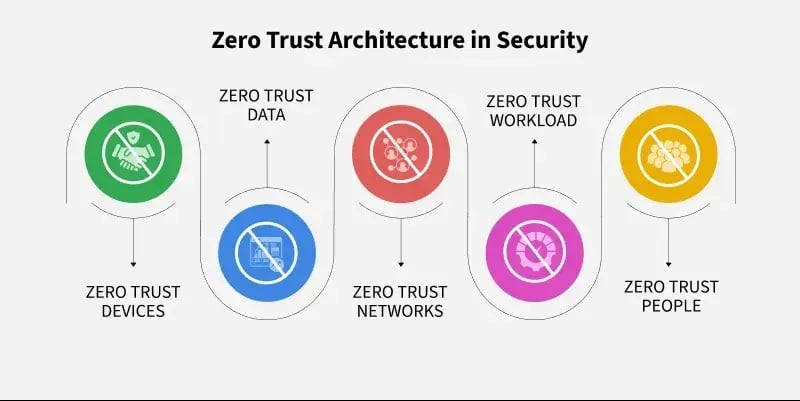
Zero Trust Architecture outlines how these principles are applied across an enterprise's systems, networks, and workflows to ensure that no entity (user, device, or application) gains access without rigorous validation.
## 
## Core principles of ZTA
The model is based on core tenets, including explicitly verifying user identity, device posture, and context before granting access. Assuming breaches are inevitable, it uses micro-segmentation and least-privilege access to contain damage, supported by continuous monitoring and real-time risk assessment for dynamic policy enforcement.
As cyber threats grow more sophisticated, traditional perimeter-based defenses are no longer sufficient. Zero Trust assumes no user, device, application, or network component is trustworthy by default; every access request must be continuously verified, regardless of origin. It is a resource-centric approach based on the idea that trust is never implicit and must be continuously evaluated. Zero Trust Architecture (ZTA) reframes how organizations protect systems, data, and users by enforcing strict, context-aware access controls across identities (human and machine), credentials, access management, operations, endpoints, hosting environments, and the networks that connect them. By treating the network as potentially compromised, Zero Trust reduces uncertainty and enforces precise, least-privilege, per-request access decisions for information systems and services, making it a critical framework for protecting your business.
### Principles of Zero Trust Architecture
These three core principles, derived from NIST SP 800-207, define how Zero Trust is operationalized to deliver continuous, context-aware security enforcement.
#### 1. **Verify Explicitly**
According to the core tenets outlined in the Zero Trust model defined in NIST SP 800-207, verification must be performed continuously and adaptively so that access decisions are driven by real-time risk evaluation. This encompasses risk-based conditional access, rapid and scalable policy enforcement, and comprehensive identity verification.
As per NIST:
- Authentication and authorization (both subject and device) are discrete functions performed before a session to an enterprise resource is established.
- Verification involves evaluating device posture, user identity, time, location, and other context before granting access.
#### 2. Use Least Privilege Access
Limit user access through Just-In-Time and Just-Enough-Access (JIT/JEA) controls, risk-based adaptive policies, and strong data protection measures.
- The principle of least privilege restricts users’ access rights to only the data, applications, and services they need to perform their authorized functions.
- Enforced through granular access controls, Just-in-Time (JIT) and Just-Enough Access (JEA) mechanisms.
- Identity-based segmentation provides a more flexible and effective way to control access, directly tied to the identity of the user or device.
As per NIST 800-207:
- Access rules are made as granular as possible to enforce the least privileges needed to act on the request.
- Authentication and authorization to one resource will not automatically grant access to a different resource.
#### 3. Assume Breach
Zero Trust operates on the premise that security breaches are inevitable and that malicious activity can originate from both inside and outside an organization’s network perimeter. A primary goal of a Zero Trust architecture is to contain and reduce the blast radius of any breach when it occurs.
Assets should always act as if an attacker is present on the enterprise network, and communication should be done in the most secure manner available. This includes:
- Micro-segmentation of sensitive resources
- End-to-end encryption
- Continuous monitoring of user and device behaviour for anomalies
- Robust incident response mechanisms
### 
## Key Components
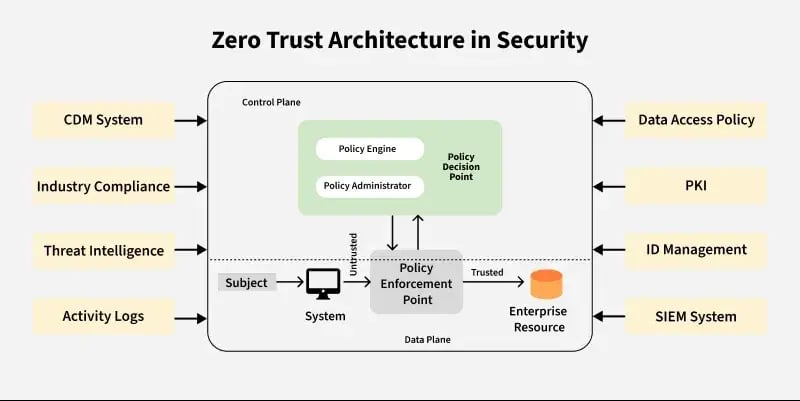
- **Policy Engine (PE)**: Evaluates access requests using data on assets, threats, and policies.
- **Policy Decision Point (PDP)**: Decides if access is allowed based on PE analysis.
- **Policy Enforcement Point (PEP)**: Applies decisions at access points, often integrated with tools like MFA and encryption.
- **Continuous Diagnostics and Mitigation (CDM):** The CDM system continuously collects the current state of enterprise assets and updates their configuration and software components.
- **Threat Intelligence Feeds:** Threat intelligence feed(s) provide information from internal or external sources that help the policy engine make access decisions.
- Security technologies such as IAM, micro-segmentation, and endpoint monitoring form the backbone.
## Zero Trust Architecture Pillars
These five foundational pillars define the core areas that Zero Trust Architecture must secure across any organization.
#### 1. Identity
Identity refers to the attributes that describe both human and non-human users. In this, controls are essential to manage each user’s access requests, ensuring that the appropriate access is granted without excessive rights. In this include
- Single Sign-On (SSO)
- Multi-Factor Authentication (MFA)
- Identity and Access Management (IAM) systems
#### 2. Devices
A device refers to any asset that can connect to a network (e.g., servers, desktops and laptops, printers, mobile devices, IoT devices, and networking equipment), including bring-your-own-device (BYOD) assets.
#### 3. Networks
A network refers to any communication channel, including internal networks, wireless, and the Internet. In this approaches include:
- Encrypting network traffic
- Microsegmentation instead of traditional segmentation
- Monitoring traffic to detect security issues and policy violations
#### 4. Applications & Workloads
Applications and workloads refer to all systems, programs, and services operating on-premises, in the cloud, or on mobile devices. Applications cannot be trusted, and continuous monitoring at runtime is necessary to validate their behavior. Zero Trust architecture directs continuous monitoring and validation of these tools to ensure secure deployment and service delivery.
#### 5. Data
Data encompasses all forms of information structured and unstructured, metadata, and fragments—stored or processed across systems, devices, applications, and networks. All data must be protected from unauthorized access and exfiltration, whether it is in motion, in use, or at rest.
#### Benefits
Zero Trust reduces attack surfaces by denying broad access post-login and enabling scalability for remote work and cloud setups. It improves visibility through logging and cuts complexity compared to legacy models. Adoption supports compliance and faster incident response.
| Aspect | Traditional Perimeter | Zero Trust |
| --- | --- | --- |
| Trust Model | Inside = trusted | Always untrusted |
| Access Control | Login-based | Per-session, dynamic |
| Visibility | Limited | Continuous monitoring |
| Lateral Movement | Possible | Blocked by segmentation |
| Scalability | Challenging | Cloud-native |
## NIST SP 800-207 overview and key requirements
NIST SP 800-207 outlines the Zero Trust Architecture (ZTA) framework, emphasizing a "never trust, always verify" model to protect resources in modern, distributed environments. Published in 2020 by NIST, it shifts security from perimeter defenses to continuous authentication and authorization for every access request, regardless of network location.
### Core Tenets
The document defines seven fundamental principles: all data sources and services are resources; no implicit trust based on network location; access decisions per request using all available data; least privilege and minimized explicit trust; dynamic policy enforcement; explicit verification; and comprehensive authentication and authorization.
### Main Components
ZTA relies on three logical components: the Policy Engine (PE) for centralized decision-making using policy, asset, and threat data; Policy Administration Point (PAP) / Policy Decision Point (PDP) for processing requests and issuing decisions; and Policy Enforcement Points (PEPs) distributed across the network to enforce access at gateways, proxies, or endpoints.
### Deployment Requirements
Organizations must first map assets and data flows, apply granular micro-segmentation, enable continuous monitoring and logging, integrate strong identity controls (such as MFA), and support hybrid deployment patterns, including device/agent-based and resource-portal models. Zero Trust relies on adaptive, telemetry-driven policies and operates on an assume-breach mindset to minimize lateral movement and contain potential compromise.
## Trust Algorithm in Zero Trust Architecture
Imagine an enterprise implementing a Zero Trust Architecture (ZTA) to protect its systems. Within this model, the Policy Engine (PE) functions as the central decision-maker, determining who can access which resources. The Trust Algorithm (TA) is the core decision process of the PE—a structured sequence of evaluations the Policy Engine runs to decide whether to permit or deny access to a given resource, such as a file, application, or network segment.
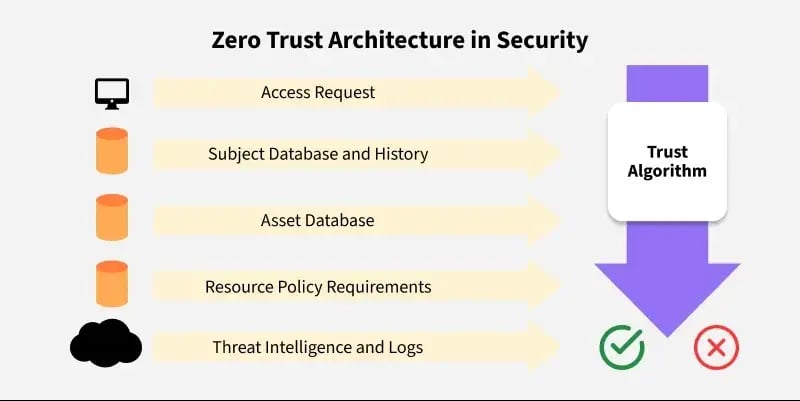
The PE takes input from multiple sources:
- **Access request**: This is the actual request from the subject. The resource requested is the primary information used, but information about the requester is also used (e.g., OS version, patch level).
- **Subject database**: This is the “who” that is requesting access. This includes human and process subjects, their attributes/privileges, and historical behavior patterns. Attributes of identity may include time and geolocation.
- **Asset database and observable status**: This contains the known state of enterprise-owned (and possibly known nonenterprise/BYOD) assets. This includes OS version, software presence and integrity, location, and patch level.
- **Resource requirements**: Policies that define the minimal requirements for access to the resource, such as authenticator assurance levels, network location, and data sensitivity.
- **Threat intelligence**: This includes attack signatures, communication patterns, newly discovered malware, and external/internal threat feeds.
## How a Zero Trust Architecture Transforms Security
Zero Trust represents a fundamental departure from traditional, perimeter-centric security architectures. Rather than focusing on securing the network itself, it secures access directly to specific IT resources. Instead of relying primarily on static identity-based controls (which can be compromised), Zero Trust evaluates context and real-time risk to determine access. A dedicated, cloud-delivered Zero Trust platform provides this architecture as a service at the edge, functioning as an intelligent switchboard to broker secure, one-to-one connections between users, devices, workloads, branches, and applications—no matter where they are located. In effect, Zero Trust decouples security and connectivity from the underlying network infrastructure. This allows organizations to safely treat the internet as their corporate network while maintaining strong, adaptive protection for every session.
### The Principles of Zero Trust
- Verify identity: Every access request begins with authenticating the identity of the user or other entity that is attempting access.
- Determine destination: The zero trust platform identifies the destination being requested and ensures that it is legitimate and safe.
- Assess risk: AI/ML evaluates the context of the access attempt in order to understand risk, factoring in user behavior, device posture, location, and countless other variables.
- **Enforce policy:** Policy is enforced in real time on a per-session basis, granting, denying, or providing an intermediate level of access based on risk in order to ensure least-privileged access.
### The Four Strengths of Zero Trust
- Minimizes the attack surface: By hiding applications behind a zero trust cloud, zero trust eliminates the need for public IP addresses and prevents inbound connections. Applications are invisible to the internet, reducing the attack surface.
- **Stops compromise:** Zero trust leverages a high-performance security cloud to proxy and inspect all traffic—including encrypted traffic—at scale. Real-time policies block threats before they reach users or applications.
- **Prevents lateral movement:** Zero trust connects users directly to applications, not the network. This granular segmentation ensures that attackers cannot move laterally between resources, effectively containing breaches.
- **Blocks data loss:** Zero trust architecture secures sensitive information across all potential data leakage channels—whether in motion to the web (even via encrypted traffic), at rest in the cloud, or in use on endpoints.
## Zero Trust in Action: Securing Any-to-Any Connectivity
One of the defining strengths of zero trust is its ability to secure any-to-any connectivity. This means it can protect any of the entities that need access to your IT resources, including your:
- Workforce: Users can securely access the web, SaaS apps, and private apps without requiring network access
- **Clouds:** Zero trust secures communications for workloads in public, private, and hybrid cloud environments, and protects data at rest in your clouds and SaaS apps
- **IoT/OT devices:** Zero trust ensures secure connectivity for IoT and operational technology (OT) systems, protecting these critical assets from cyberattacks
- **B2B partners:** Third-parties like channel partners gain secure access directly to specific apps, without the need for VPNs or network-level access
## Traditional Architectures vs Zero Trust Architecture (ZTA)
How security models differ in trust, access, enforcement, and adaptability across IT environments.
| **Traditional Architectures** | **Zero Trust Architecture (ZTA)** |
| --- | --- |
| Trust granted implicitly inside network perimeter | No implicit trust; trust is never assumed |
| Perimeter-based: Firewalls, VPNs, “castle-and-moat” model | No clear perimeter; protects resources anywhere |
| Broad access after login | Per-session dynamic access with least privilege |
| Devices/users inside perimeter considered safe | Every request treated as untrusted by default |
| Authentication only during login | Continuous authentication & authorization |
| Limited visibility; encrypted traffic hard to inspect | Full visibility with continuous diagnostics & monitoring |
| Lateral movement possible once inside | Prevents lateral movement via micro-segmentation |
| Hard to scale (centralized infrastructure) | Easily scales across cloud, hybrid, and mobile environments |
## **Beyond Security: The Business Benefits of Zero Trust **
In addition to reducing cyber risk, zero trust delivers several operational and financial benefits:
- **Reduced complexity:** By replacing firewalls, VPNs, and various point solutions with a unified, modern platform, organizations can simplify their IT environments.
- **Cost savings:** Eliminating legacy tools while simplifying security and networking reduces management overhead and lowers total cost of ownership (TCO).
- **Enhanced user experience:** Direct-to-app connectivity eliminates the latency associated with backhauling traffic, ensuring fast, seamless access for users and enhancing productivity.
- **Enterprise agility:** Zero trust is a flexible architecture that enables organizations to secure cloud applications and hybrid work, empowering them to adapt quickly and safely to changing business needs.
## Benefits of Zero Trust Architecture
By implementing zero trust architecture, any organization can benefit in the following ways:
1. **Enhanced Security**: Enforces least-privilege access, reducing attack surfaces and continuous authentication prevents unauthorized access, minimizing insider and outsider threats.
2. **Protection Against Data Breaches**: Authentication for every request reduces breach risk, Assumes breach and limits lateral movement within the network.
3. **Improved Visibility and Monitoring**: Continuous monitoring and logging improve threat detection, Better audit trails for more effective responses.
4. **Reduced Risk of Advanced Persistent Threats (APTs)**: Isolates network segments and verifies access at each level, minimizing the impact of APTs.
5. **Scalability**: Easily scales with the growing number of users, devices, and applications.
6. **Improved Incident Response**: Granular control helps security teams quickly identify and isolate compromised resources.
7. **Support for Remote Work and Cloud Environments**: Secures distributed work forces and multi-cloud environments.
8. **Addresses Compliance Requirements**: Aligns with regulations like GDPR, HIPAA, and PCI-DSS.
9. **Reduces Insider Threats**: Limits access to necessary resources, preventing lateral movement and exposure.
## **Conclusion**
Zero Trust Architecture is a security model that requires every user, device, and application to be continuously verified, regardless of where they are located. Anchored in the core principle of “never trust, always verify,” it strengthens an organization’s ability to safeguard sensitive data and critical resources against both internal and external threats. By enforcing ongoing authentication and tightly segmenting access, Zero Trust minimizes unauthorized access and helps contain potential breaches when they occur.
A comprehensive Zero Trust strategy integrates multiple security domains, including user and device security, application and data protection, and infrastructure security. Through a structured approach built on strong authentication, encryption, least-privilege access, and continuous monitoring, organizations can significantly decrease their exposure to cyberattacks. In doing so, they gain key advantages such as stronger security posture, deeper visibility into activity, improved protection against data breaches, and scalable controls that support both cloud environments and distributed workforces. Zero Trust also helps organizations meet regulatory requirements for data protection and enhances their ability to detect, respond to, and remediate incidents quickly.
As digital transformation accelerates, organizations need a security architecture that can keep pace. Legacy perimeter-based models, with their implicit trust zones and broad internal access, are no longer adequate. Zero Trust Architecture, with its focus on secure, any-to-any connectivity and dynamic, context-driven policies, offers a modern answer to today’s cybersecurity challenges. When augmented with AI-driven analytics and automation, Zero Trust can further improve security efficacy, streamline operations, and enhance user experiences.
Platforms like the Zero Trust Exchange exemplify this approach by brokering secure, direct connections between users, devices, applications, and workloads while keeping everything else hidden and protected. This allows businesses to embrace cloud adoption and hybrid work with confidence, securely connecting users to resources without exposing the underlying network. For organizations ready to move forward, the journey to Zero Trust begins with a clear understanding of its principles, core strengths, and practical implementation strategies—and with a commitment to continuously evolve security controls as threats and business requirements change.
**Tags:**
[Generative AI,](https://www.findernest.com/en/blog/tag/generative-ai) [Intelligent Automation,](https://www.findernest.com/en/blog/tag/intelligent-automation) [Innovation,](https://www.findernest.com/en/blog/tag/innovation) [Managed Services,](https://www.findernest.com/en/blog/tag/managed-services) [Solution Architecture,](https://www.findernest.com/en/blog/tag/solution-architecture) [Implementation,](https://www.findernest.com/en/blog/tag/implementation) [AI (Artificial Intelligence),](https://www.findernest.com/en/blog/tag/ai-artificial-intelligence) [Business Intelligence,](https://www.findernest.com/en/blog/tag/business-intelligence) [Cybersecurity,](https://www.findernest.com/en/blog/tag/cybersecurity) [Robotic Process Automation (RPA),](https://www.findernest.com/en/blog/tag/robotic-process-automation-rpa) [Software Development,](https://www.findernest.com/en/blog/tag/software-development) [Governance,](https://www.findernest.com/en/blog/tag/governance) [Data Security,](https://www.findernest.com/en/blog/tag/data-security) [Cloud Security](https://www.findernest.com/en/blog/tag/cloud-security)

Post by [Praveen Gundala](https://www.findernest.com/en/blog/author/praveen-gundala)
Praveen Gundala, Founder and Chief Executive Officer of FindErnest, provides value-added information technology and innovative digital solutions that enhance client business performance, accelerate time-to-market, increase productivity, and improve customer service. FindErnest offers end-to-end solutions tailored to clients' specific needs. Our persuasive tone emphasizes our dedication to producing outstanding outcomes and our capacity to use talent and technology to propel business success. I have a strong interest in using cutting-edge technology and creative solutions to fulfill the constantly changing needs of businesses. In order to keep up with the latest developments, I am always looking for ways to improve my knowledge and abilities. Fast-paced work environments are my favorite because they allow me to use my drive and entrepreneurial spirit to produce amazing results. My outstanding leadership and communication abilities enable me to inspire and encourage my team and create a successful culture.
[Follow me on my website](https://www.findernest.com) [Follow me on Facebook](https://www.facebook.com/teamfindernest) [Follow me on LinkedIn](https://www.linkedin.com/company/findernest) [Follow me on Twitter](https://x.com/findernestteam)
### Related Articles
##### [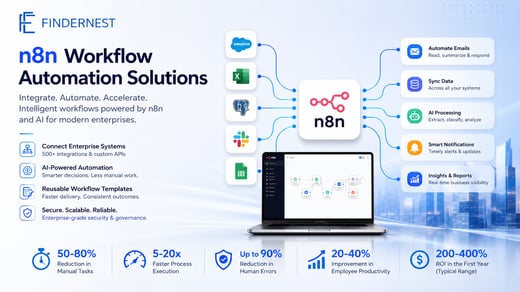 Generative AI • 29 June, 2026 11:08:15 AM IST n8n Workflow Automation Services | AI Business Automation | FindErnest 3 min read](https://www.findernest.com/en/blog/n8n-workflow-automation-enterprise-ai-findernest)
##### [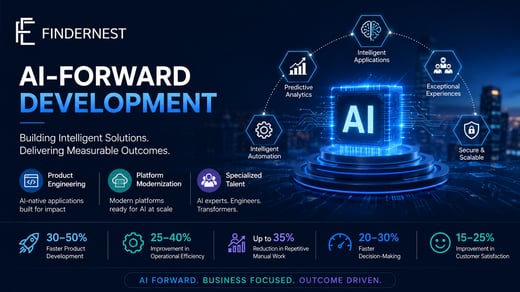 Generative AI • 23 June, 2026 8:12:51 PM IST AI-Forward Development: Transforming Enterprises for the Future 3 min read](https://www.findernest.com/en/blog/ai-forward-development-transforming-enterprises-for-the-future)
##### [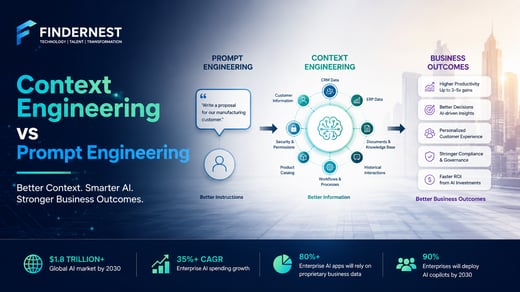 Generative AI • 23 June, 2026 7:36:52 PM IST Context Engineering: The Next Frontier in Enterprise AI Transformation 6 min read](https://www.findernest.com/en/blog/context-engineering-the-next-frontier-in-enterprise-ai-transformation)
## Comments
###### Categories
- [Technology](https://www.findernest.com/en/blog/tag/technology)
- [Business Intelligence](https://www.findernest.com/en/blog/tag/business-intelligence)
- [Operations](https://www.findernest.com/en/blog/tag/operations)
- [Business Consulting](https://www.findernest.com/en/blog/tag/business-consulting)
- [Managed Services](https://www.findernest.com/en/blog/tag/managed-services)
- [Innovation](https://www.findernest.com/en/blog/tag/innovation)
- [Intelligent Automation](https://www.findernest.com/en/blog/tag/intelligent-automation)
- [Solution Architecture](https://www.findernest.com/en/blog/tag/solution-architecture)
- [Software Development](https://www.findernest.com/en/blog/tag/software-development)
- [AI (Artificial Intelligence)](https://www.findernest.com/en/blog/tag/ai-artificial-intelligence)
- [Implementation](https://www.findernest.com/en/blog/tag/implementation)
- [Engineering as a Service](https://www.findernest.com/en/blog/tag/engineering-as-a-service)
- [Governance](https://www.findernest.com/en/blog/tag/governance)
- [Application Development](https://www.findernest.com/en/blog/tag/application-development)
- [Configuration](https://www.findernest.com/en/blog/tag/configuration)
- [DevOps](https://www.findernest.com/en/blog/tag/devops)
- [Generative AI](https://www.findernest.com/en/blog/tag/generative-ai)
- [Outsourcing](https://www.findernest.com/en/blog/tag/outsourcing)
- [Framework](https://www.findernest.com/en/blog/tag/framework)
- [Digital Transformation](https://www.findernest.com/en/blog/tag/digital-transformation)
###### Recent Posts
- [FindErnest Vision 2030: Leading AI-First Transformation and Innovation](https://www.findernest.com/en/blog/findernest-vision-2030-leading-ai-first-transformation-and-innovation)
- [Microsoft Security Services: XDR, Sentinel & Zero Trust by FindErnest](https://www.findernest.com/en/blog/microsoft-security-services-xdr-sentinel-zero-trust-by-findernest)
- [Zoho Implementation, Deluge & Managed Services | FindErnest](https://www.findernest.com/en/blog/zoho-implementation-deluge-managed-services-findernest)
- [Enterprise Migration Factory: Governance, Automation & Best Practices](https://www.findernest.com/en/blog/enterprise-migration-factory-governance-automation-best-practices)
- [GCC Readiness Assessment | Global Capability Center | FindErnest](https://www.findernest.com/en/blog/gcc-readiness-assessment-global-capability-center-findernest)
- [n8n Workflow Automation Services | AI Business Automation | FindErnest](https://www.findernest.com/en/blog/n8n-workflow-automation-enterprise-ai-findernest)
- [AI-Forward Development: Transforming Enterprises for the Future](https://www.findernest.com/en/blog/ai-forward-development-transforming-enterprises-for-the-future)
- [AI-Powered Social Research: Transforming Conversations into Growth](https://www.findernest.com/en/blog/ai-powered-social-research-transforming-conversations-into-growth)
- [Context Engineering: The Next Frontier in Enterprise AI Transformation](https://www.findernest.com/en/blog/context-engineering-the-next-frontier-in-enterprise-ai-transformation)
- [Cybersecurity & Identity Solutions: Building Secure Digital Enterprise](https://www.findernest.com/en/blog/cybersecurity-identity-solutions-building-secure-digital-enterprise)
- [ERP & Enterprise Applications: Key Drivers of Modern Business Growth](https://www.findernest.com/en/blog/erp-enterprise-applications-key-drivers-of-modern-business-growth)
- [End-to-End Product Development for Digital-First Enterprises](https://www.findernest.com/en/blog/end-to-end-product-development-for-digital-first-enterprises)
- [Platform Engineering Services: Boosting Productivity and Innovation](https://www.findernest.com/en/blog/platform-engineering-services-boosting-productivity-and-innovation)
- [Why Modern Enterprises Need End-to-End Digital Transformation Services](https://www.findernest.com/en/blog/why-modern-enterprises-need-end-to-end-digital-transformation-services)
- [Top Benefits of Using HubSpot CMS for Your Business](https://www.findernest.com/en/blog/top-benefits-of-using-hubspot-cms-for-your-business)
[](https://www.findernest.com)
## Enterprise Transformation Powered by Expertise, Excellence & Execution
Have a question? Feel free to reach out to info@findernest.com / +917207788004
-
-
-
-
-
-
- Solutions
- [Digital Transformation](https://www.findernest.com/digital-transformation-solutions)
- [AI & Intelligent Automation](https://www.findernest.com/ai)
- [Platform/Product Engineering](https://www.findernest.com/product-development-platform-engineering-services)
- [Business Consulting](https://www.findernest.com/business-consulting-services)
- [Cloud Transformation](https://www.findernest.com/cloud)
- [Data & Analytics](https://www.findernest.com/data)
- [Managed IT Services](https://www.findernest.com/managed-it-services-support)
- [Talent Solutions](https://www.findernest.com/talent-solutions)
- [Partnerships](https://www.findernest.com/platforms)
- [AWS](https://www.findernest.com/aws)
- [Oracle](https://www.findernest.com/oracle)
- [Microsoft](https://www.findernest.com/microsoft)
- [Zoho](https://www.findernest.com/zoho)
- [SAP](https://www.findernest.com/sap)
- [Databricks](https://www.findernest.com/databricks)
- [Hubspot](https://www.findernest.com/hubspot)
- [Salesforce](https://www.findernest.com/salesforce)
- [Service Now](https://www.findernest.com/servicenow)
- [About us](https://www.findernest.com/about)
- [Who we are](https://www.findernest.com/about)
- [How we Engage](https://www.findernest.com/how-we-work)
- [Careers](https://findernest.zohorecruit.in/jobs/Careers)
- [Blog & Insights](https://www.findernest.com/en/blog)
- [Sustainability](https://www.findernest.com/sustainability)
- [Community Guidelines](https://www.findernest.com/policy)
- [Privacy Policy](https://www.findernest.com/privacy)
- [Terms & Conditions](https://www.findernest.com/terms)
© 2026 FindErnest, Inc. All rights reserved. [Privacy Policy](https://www.findernest.com/privacy) | [Acceptable Use Policy](https://www.findernest.com/policy) | [Terms and Conditions](https://www.findernest.com/terms)
```json
{
"@context" : "https://schema.org",
"@type" : "BlogPosting",
"author" : {
"@type" : "Person",
"name" : "Praveen Gundala",
"url" : "https://www.findernest.com/en/blog/author/praveen-gundala"
},
"dateModified" : "2025-12-22T20:19:58.855Z",
"datePublished" : "2025-12-22T20:11:42.000Z",
"headline" : "Zero Trust Security: A Comprehensive Guide to Enhanced Cyber Defense",
"image" : [ "https://www.findernest.com/hubfs/Zero%20Trust%20Security%20A%20Comprehensive%20Guide.png" ],
"mainEntityOfPage" : {
"@id" : "https://www.findernest.com/en/blog/zero-trust-security-a-comprehensive-guide-to-enhanced-cyber-defense",
"@type" : "WebPage"
},
"publisher" : {
"@type" : "Organization",
"logo" : {
"@type" : "ImageObject",
"url" : "https://www.findernest.com/hubfs/FINDERNEST%20LOGO.png"
},
"name" : "FindErnest"
}
}
```
```json
{
"@context" : "https://schema.org",
"@id" : "https://findernest.com/#organization",
"@type" : [ "Organization", "ProfessionalService" ],
"alternateName" : "FindErnest Software Services",
"areaServed" : [ {
"@type" : "Country",
"name" : "India"
}, {
"@type" : "Country",
"name" : "United States"
}, {
"@type" : "Country",
"name" : "United Kingdom"
}, {
"@type" : "Country",
"name" : "Canada"
}, {
"@type" : "Country",
"name" : "Australia"
}, {
"@type" : "Country",
"name" : "Singapore"
}, {
"@type" : "Country",
"name" : "United Arab Emirates"
}, {
"@type" : "Country",
"name" : "Saudi Arabia"
}, {
"@type" : "Country",
"name" : "Qatar"
}, {
"@type" : "Country",
"name" : "Kuwait"
}, {
"@type" : "Country",
"name" : "Bahrain"
}, {
"@type" : "Country",
"name" : "Oman"
}, {
"@type" : "Country",
"name" : "Germany"
}, {
"@type" : "Country",
"name" : "France"
}, {
"@type" : "Country",
"name" : "Netherlands"
}, {
"@type" : "Country",
"name" : "Belgium"
}, {
"@type" : "Country",
"name" : "Switzerland"
}, {
"@type" : "Country",
"name" : "Sweden"
}, {
"@type" : "Country",
"name" : "Denmark"
}, {
"@type" : "Country",
"name" : "Norway"
}, {
"@type" : "Country",
"name" : "Ireland"
} ],
"description" : "FindErnest is a Technology, Talent and Transformation Partner helping enterprises accelerate growth through Product Engineering, Platform Engineering, Managed Services, AI Solutions, Digital Transformation, Workforce Solutions, and Enterprise Platform Services.",
"email" : "info@findernest.com",
"foundingDate" : "2022",
"hasOfferCatalog" : {
"@type" : "OfferCatalog",
"itemListElement" : [ {
"@type" : "OfferCatalog",
"name" : "Cloud Platforms"
}, {
"@type" : "OfferCatalog",
"name" : "Enterprise Applications"
}, {
"@type" : "OfferCatalog",
"name" : "CRM & Customer Experience Platforms"
}, {
"@type" : "OfferCatalog",
"name" : "Identity & Security Platforms"
}, {
"@type" : "OfferCatalog",
"name" : "IT Operations & Managed Services Platforms"
}, {
"@type" : "OfferCatalog",
"name" : "Product Engineering"
}, {
"@type" : "OfferCatalog",
"name" : "Platform Engineering"
}, {
"@type" : "OfferCatalog",
"name" : "Talent Solutions"
}, {
"@type" : "OfferCatalog",
"name" : "Contingent Workforce Solutions"
}, {
"@type" : "OfferCatalog",
"name" : "Business Consulting & Outsourcing"
}, {
"@type" : "OfferCatalog",
"name" : "AI & Data Platforms"
} ],
"name" : "FindErnest Platform Solutions"
},
"image" : "https://findernest.com/assets/images/findernest-logo.png",
"knowsAbout" : [ "Artificial Intelligence", "Generative AI", "AI Development", "Product Engineering", "Platform Engineering", "Digital Transformation", "Managed Services", "Technology Consulting", "Cloud Migration", "Cloud Modernization", "Talent Solutions", "Workforce Transformation", "Identity and Access Management", "Automation", "Business Process Optimization", "Customer Experience Platforms", "Enterprise Applications", "AWS", "SAP", "Oracle", "Microsoft", "Google Cloud", "Zoho", "Databricks", "ServiceNow", "Workday", "OutSystems", "miniOrange", "HubSpot", "SuperOps", "Salesforce", "Spin.AI", "Pega" ],
"logo" : "https://findernest.com/assets/images/findernest-logo.png",
"name" : "FindErnest",
"sameAs" : [ "https://www.linkedin.com/company/findernest", "https://www.instagram.com/teamfindernest", "https://www.facebook.com/teamfindernest" ],
"telephone" : "+91-7207788004",
"url" : "https://findernest.com"
}
```