For growing technology companies, adding engineering capacity is rarely just a hiring decision. It is a business decision that affects product velocity, delivery timelines, operational complexity, and long-term scalability.
When a product roadmap expands, engineering leaders often face a familiar challenge: should they add individual specialists through staff augmentation, or build a dedicated engineering team that works as an extension of their organization?
Both approaches can solve capacity challenges, but they are designed for different situations. Staff augmentation can help companies quickly address specific skill gaps, while dedicated teams are built for organisations that need sustained engineering capability, stronger collaboration, and long-term product ownership.
The right choice depends on more than cost. It depends on how quickly a team can become productive, how much management effort is required, and whether the engagement model supports the company’s growth stage.
The real cost of scaling an engineering team
A common mistake in technology planning is evaluating engineering models only by hourly rates or immediate hiring costs.
The actual cost includes several factors: recruitment effort, onboarding time, management bandwidth, knowledge transfer, delivery coordination, and the impact of team continuity on product execution.
According to the DevOps Research and Assessment (DORA) research program, high-performing software teams are measured not only by delivery speed but also by deployment frequency, lead time for changes, change failure rate, and recovery time. These metrics highlight an important point: engineering productivity is not simply about having more developers; it is about how effectively teams deliver value.
For scaleups, the question is therefore not just “How do we add engineers?” but “How do we create a delivery model that improves engineering outcomes?”
Dedicated Team vs. Staff Augmentation: Understanding the difference
Staff augmentation is typically used when a company already has an internal engineering structure and needs additional expertise or temporary capacity.
For example, a company may need additional backend developers for a product release, a cloud specialist for a migration initiative, or a data engineer for a defined period. In this model, the external professionals usually work under the client’s existing management structure.
A dedicated team model takes a broader approach. It creates a dedicated group of professionals aligned with the company’s product goals and delivery processes. Depending on business requirements, the team can include software engineers, QA professionals, DevOps engineers, cloud specialists, UX resources, and other technical roles.
FindErnest’s dedicated team model is designed for long-term engineering scale, where clients receive exclusive engineering pods supported by capabilities such as QA, DevOps, and UX resources. FindErnest manages areas such as hiring pipeline, workspace tooling, payroll, and core technical governance while the team works as an extension of the client organisation.
A simple comparison:
|
Factor
|
Staff Augmentation
|
Dedicated Team
|
|
Primary purpose
|
Fill specific skill or capacity gaps
|
Build long-term engineering capability
|
|
Management model
|
Client manages daily priorities and delivery
|
Team operates with structured collaboration and governance
|
|
Best suited for
|
Short-term needs, specialist requirements, temporary scaling
|
Product development, continuous improvement, long-term roadmaps
|
|
Team structure
|
Individual contributors added as needed
|
Cross-functional team aligned with business goals
|
Neither model is universally better. The right option depends on the company’s product maturity, internal capabilities, and future roadmap.
Measuring velocity: where dedicated teams create an advantage
Engineering velocity is not only determined by how quickly developers join a project. It also depends on how quickly they understand the product, architecture, workflows, and business objectives.
With staff augmentation, companies can often add specific expertise quickly. However, internal teams usually remain responsible for assigning work, managing priorities, and ensuring alignment.
Dedicated teams require more upfront planning because the objective is to create a stable delivery unit. Once established, this continuity can reduce repeated onboarding cycles and allow knowledge to compound over time.
This becomes especially valuable for scaleups building complex platforms where engineering decisions made today influence future development.
A dedicated team can support broader technology requirements across modern development environments, including frontend frameworks such as React and Angular, backend technologies including .NET, Java, Node.js, Python, and Go, along with cloud platforms such as AWS, Azure, and Google Cloud.
Cost benchmark: what can and cannot be measured
There is no universal cost percentage that applies to every dedicated team or staff augmentation engagement. Costs vary significantly depending on geography, seniority, technology stack, engagement structure, and the level of management support required.
Reliable benchmarks are easier to establish around engineering performance than around engagement pricing.
For example, theState of DevOps Report has consistently shown that elite software teams outperform lower-performing teams across delivery metrics such as deployment frequency and lead time for changes. These benchmarks reinforce why engineering operating models matter alongside team size.
When evaluating cost, technology leaders should consider:
- How much internal management time will be required?
- How quickly will new engineers become productive?
- Will the team retain product knowledge over multiple releases?
- Does the engagement support changing requirements?
A lower short-term cost may not always create better long-term value if it increases coordination effort or slows delivery.
The trade-offs of dedicated teams
Dedicated teams offer strong advantages for companies that need sustained engineering capacity, but they are not without considerations.
One potential challenge is utilization. If a company builds a dedicated team but does not have a consistent product roadmap or sufficient workload, the fixed team structure may create unnecessary cost.
Companies should also consider vendor dependency. A long-term external engineering relationship requires clear documentation, knowledge-sharing processes, and governance to avoid operational risks.
Alignment can also become a challenge. Distributed teams may face communication gaps, differences in working styles, or cultural friction if collaboration practices are not established early. Research on distributed software development has highlighted communication challenges as one of the key risks organisations must actively manage.
However, these challenges are manageable when companies establish clear ownership, communication routines, technical standards, and shared delivery practices.
For businesses with evolving products, ambitious roadmaps, or limited access to specialised talent, the benefits of a dedicated team often outweigh these considerations.
A real-world example: accelerating enterprise transformation
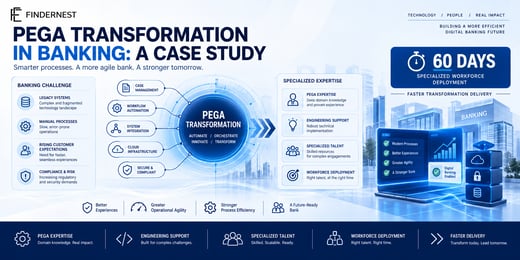
FindErnest’s public case study on rapid Pega solutions demonstrates how technology teams can help organisations accelerate digital initiatives.
In the case study, FindErnest highlights the implementation of Pega solutions to transform banking operations within 60 days. The example focuses on using technology expertise to support faster operational transformation through enterprise platform capabilities.
While this example is not a direct comparison between dedicated teams and staff augmentation, it reflects an important principle behind successful technology partnerships: organizations need the right combination of technical expertise, execution capability, and delivery structure to move transformation initiatives forward.
When should companies choose staff augmentation?
Staff augmentation remains a practical choice when the requirement is focused and temporary.
It works well when:
- Internal engineering leaders already have strong delivery processes
- A company needs a specific technical skill quickly
- The requirement is linked to a short-term milestone
- The organization wants direct control over task management
For example, a SaaS company with an experienced engineering team may bring in additional cloud engineers during a migration project without changing its overall operating model.
When does a dedicated team make more sense?
A dedicated team is better suited for companies that view engineering capacity as a long-term strategic capability.
It is particularly useful when:
- Product development is continuous and evolving
- Multiple technical roles are required
- Internal hiring cannot keep pace with growth
- Product knowledge and engineering continuity are important
- The business wants a long-term technology partner
FindErnest supports organizations through flexible engagement models, including dedicated engineering teams, staff augmentation, managed services, and other delivery approaches depending on business objectives and delivery maturity.
Choosing the right engineering model for your growth stage
The decision between staff augmentation and a dedicated team should start with business requirements, not simply resource availability.
Engineering leaders should evaluate:
- The expected duration of the initiative
- The complexity of the product environment
- The level of ownership required
- Internal team maturity
- Future scaling requirements
A short-term capability gap may require additional specialists. A long-term product journey may require a dedicated engineering structure.
The strongest technology strategies are built around choosing the right operating model at the right time.
Final thoughts
Engineering scale is not created by adding more people alone. It comes from building teams that can collaborate effectively, maintain product context, and consistently deliver business value.
Staff augmentation and dedicated teams both have an important role in modern technology organizations. The difference lies in the level of ownership, continuity, and collaboration required.
For companies evaluating their next phase of engineering growth, the first step is understanding which engagement model aligns with their roadmap, architecture needs, and delivery goals.
FindErnest can help technology leaders assess their current engineering capacity, product requirements, and scaling objectives through an engagement model discussion or architecture and capacity assessment to identify the most suitable path forward.


Comments